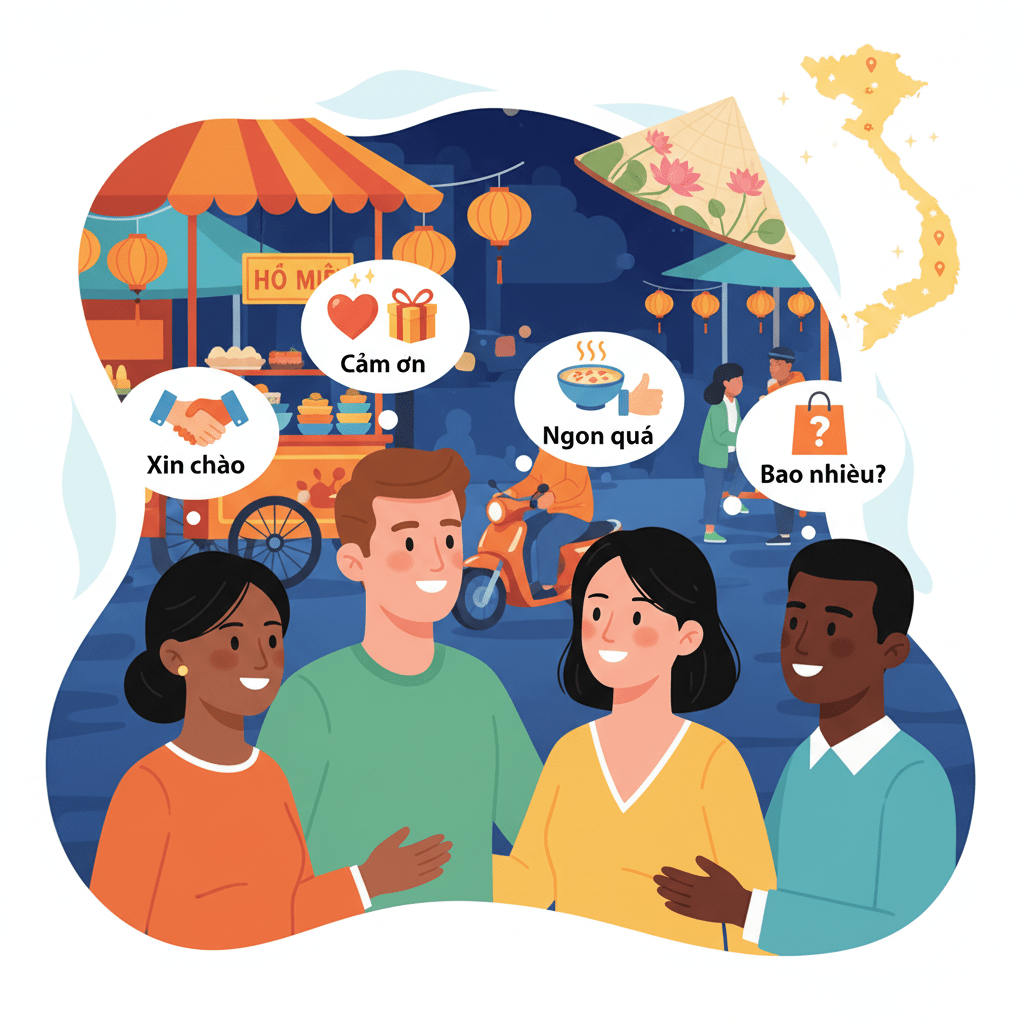
ntroduction: Unlock Your Trip with Simple Vietnamese 🔑
Planning a trip to Hanoi, Ho Chi Minh City, or Da Nang? Or maybe you just want to impress your Vietnamese friends?
While many locals speak English, using even a few basic Vietnamese phrases shows respect and can unlock warmer interactions, better service, and even lower prices!
Forget the phrasebooks—here are the 10 most essential and practical Vietnamese phrases that every traveler and beginner should master, taught by a certified Vietnamese tutor.
Part 1: Greetings and Essentials (The Basics) 👋
These phrases are your foundation for any conversation:
| Vietnamese Phrase | Pronunciation Tip | English Meaning | Usage Context |
| Xin Chào | (Sin Chao) | Hello / Hi | Used in all situations, formal or informal. |
| Cảm Ơn | (Gahm Uhn) | Thank You | Crucial when receiving help or service. |
| Xin Lỗi | (Sin Loy) | Sorry / Excuse Me | Used to apologize or to get someone’s attention. |
| Tạm Biệt | (Tarm Bee-yet) | Goodbye | Used when ending a conversation. |
| Có / Không | (Gaw / Kohng) | Yes / No | Note: In conversation, people often use Dạ (Yes, polite). |
Part 2: Getting Around & Shopping (Survival Phrases) 🛍️
These are crucial for navigating markets, taxis, and restaurants:
| Vietnamese Phrase | Pronunciation Tip | English Meaning | Usage Context |
| Bao nhiêu? | (Bao Nhyew?) | How much? | Necessary when shopping or asking for prices. |
| Tính tiền! | (Tin Tee-en!) | Check, please! | Used to request the bill at a restaurant. |
| Ngon quá! | (Ngawn Gwah!) | Delicious! | Use this to compliment the food and please the vendor. |
| Đắt quá! | (Daht Gwah!) | Too expensive! | Used when bargaining (very common in markets). |
| Ở đâu? | (Uh Dow?) | Where is…? | Used for asking directions (e.g., Nhà vệ sinh ở đâu? – Where is the bathroom?). |
Part 3: One Simple Rule to Sound More Respectful 🙏
Vietnamese is structured around respect. Adding simple particles can instantly make you sound more polite:
- Add
ạordạ: Add these to the end of a question or response to make the sentence polite.- Example: Instead of saying “Cảm ơn”, say “Cảm ơn ạ” (Thank you, ma’am/sir).
- Use the correct pronouns: Even when asking for the bill, know whether you are talking to an Anh (older man), Chị (older woman), or Em (younger person).
Conclusion: Start Speaking, Start Exploring 🚀
You don’t need to be fluent to have meaningful interactions in Vietnam. Just learning these 10 phrases and practicing the tones will dramatically improve your experience and show genuine interest in the culture.
The best way to solidify these phrases? Using them with a native speaker who can correct your tones!
Ready for Real-Life Conversation Practice? 🗣️
Learning from a blog is a great start, but nothing beats personalized one-on-one practice. I will help you master the tones and social context of every phrase you learn.
I’m Lam, your certified tutor, ready to guide you from basic phrases to fluent conversation.
Click here to contact me and book your trial lesson to start talking like a local!
 Certified Online Vietnamese Tutor | Learn Vietnamese with Lam
Leave a comment